Blank copy
Use to help with Supercorrections!
Showing posts with label unit 3. Show all posts
Showing posts with label unit 3. Show all posts
Friday, December 21, 2012

Thursday, December 13, 2012
Friday, December 7, 2012
Mr. O'B's AP Exam!!!
Mr. O'Brien graduated from Camden-Rockport High School in 1990. How would you do on his AP Calculus exam? Let's try Question 4!
Wednesday, December 5, 2012
Scribe Post 12/5
At the start of class, O'Brien told us that unit three was finally drawing to a close, and that our final topic, related rates, would occupy our final two classes before the test, and that we would be supercorrecting the test going into our Christmas -- Hanukka -- Quanza -- Saturnalia... HOLIDAY break. Surely that's the best gift of all: forgiveness for our failures on opportunity day.
But before class could begin, a scribe had to be chosen, for Eddie, awake until 1:30 the night before slaving away on his scribe post, had forgotten to name his successor. The class quickly divided into two factions pleading not to be chosen: the Phyzards and the Bio-Nerds, complaining about "supercorrections" and "bio outlines" respectively. Even Gabe and Duncan of no-supercorrections did not step forward. Eddie was overwhelmed, but just as O'Brien was about to choose randomly from the mob, Crockett rose above the masses, a beacon of hope (see fig. 1) and volunteered his evening for the benefit of Phyzards and Bio-Nerds alike. Crockett's hair flowed back in a sudden classroom breeze and women swooned at his courage and selflessness.
Given a circular cone of height 10cm and radius r, increasing at a rate of 1 cm/s, what is the rate of change of the volume when the radius is 24?
O'Brien gave us a sort of loose procedure for problems like these:
1. Write what you know.
in this case we know that:
r = 24 cm
dr/dt = 1 cm/s
h = 10 cm
2. Draw a picture.
Drawing pictures makes it easier to find relationships. A helpful tactic is to superimpose your drawing over a set of axes, then maybe write some equations for lines that you see.
3. Find relationships.
To do this problem, we have to know that the volume of a cone is equal to 1/3Bh, or 1/3πr^2h
O'Brien told us that if we have equations for our variables, it's not always best to immediately substitute those in. However, if the value is a constant, we should substitute in immediately in order to avoid messy product rules.
Because h is constant, we substituted that in, leaving us with:
V = 10π/3 * r^2
4. Do calculus.
This is the easy part. If you've done the rest of the problem in a
We're trying to find the time rate of change of V, so we have to differentiate the function we just found with respect to t. "But our equation for V is in terms of r," you might claim, but implicit differentiation allows us to take the derivative anyway:
V' = 10π/3 * 2r * dr/dt
What's that? We have a dr/dt term! But that's okay, because dr/dt and r are both given values:
V' = 10π/3 * 2(24) * 1
This video is a pretty good explanation of related rates problems:
There is a series of videos by PatrickJMT on related rates problems that you can find here:
ALEX CRANS WILL BE THE NEXT SCRIBE
But before class could begin, a scribe had to be chosen, for Eddie, awake until 1:30 the night before slaving away on his scribe post, had forgotten to name his successor. The class quickly divided into two factions pleading not to be chosen: the Phyzards and the Bio-Nerds, complaining about "supercorrections" and "bio outlines" respectively. Even Gabe and Duncan of no-supercorrections did not step forward. Eddie was overwhelmed, but just as O'Brien was about to choose randomly from the mob, Crockett rose above the masses, a beacon of hope (see fig. 1) and volunteered his evening for the benefit of Phyzards and Bio-Nerds alike. Crockett's hair flowed back in a sudden classroom breeze and women swooned at his courage and selflessness.
 | |
| fig. 1: Crockett emerges just as the Phyzards and Bio-Nerds are at each others throats. |
Related Rates
O'Brien then gave us a problem:Given a circular cone of height 10cm and radius r, increasing at a rate of 1 cm/s, what is the rate of change of the volume when the radius is 24?
O'Brien gave us a sort of loose procedure for problems like these:
1. Write what you know.
in this case we know that:
r = 24 cm
dr/dt = 1 cm/s
h = 10 cm
2. Draw a picture.
Drawing pictures makes it easier to find relationships. A helpful tactic is to superimpose your drawing over a set of axes, then maybe write some equations for lines that you see.
3. Find relationships.
To do this problem, we have to know that the volume of a cone is equal to 1/3Bh, or 1/3πr^2h
O'Brien told us that if we have equations for our variables, it's not always best to immediately substitute those in. However, if the value is a constant, we should substitute in immediately in order to avoid messy product rules.
Because h is constant, we substituted that in, leaving us with:
V = 10π/3 * r^2
4. Do calculus.
This is the easy part. If you've done the rest of the problem in a
We're trying to find the time rate of change of V, so we have to differentiate the function we just found with respect to t. "But our equation for V is in terms of r," you might claim, but implicit differentiation allows us to take the derivative anyway:
V' = 10π/3 * 2r * dr/dt
What's that? We have a dr/dt term! But that's okay, because dr/dt and r are both given values:
V' = 10π/3 * 2(24) * 1
This video is a pretty good explanation of related rates problems:
There is a series of videos by PatrickJMT on related rates problems that you can find here:
ALEX CRANS WILL BE THE NEXT SCRIBE
Tuesday, December 4, 2012
Scribe Post 12/3
We began our beautifully wonderful mathematics experience on this fine day by going over the Unit 3 Quiz #2. Before we looked at the quiz, however, O'Brien informed our class that many of his Calculus students (our class especially) have been putting off the homework, and therefore many more people did less than excellently on the quiz. :( He also informed us that a mere one singular person passed in their IW 1-5 packet on time. Shame on us. :'(
After everybody stood up and saluted O'Brien, swearing on our sacred Calculus books that we would never again do an act so deplorable as that ever EVER again, we moved on to correcting the quiz.
Quiz problems went over in class:
1. nDeriv it! Why do more work than you have to? We're nothing but lazy high school students, and we need to act like it!
2. Double derive! At the points where y''=0 is where it changes from concave up to concave down.
3. Derive and conquer! *cough* nDeriv *cough*
4. Concavity occurs at points where p'' crosses the x-axis. function "p" is concave up when p'' is positive and it is concave down when p'' is negative.
5. Product rule and chain rule dat shindig. Once you get a super messy f '(x), then you can solve it just like O'Brien did like this:
 Voilá! it's beautiful!
6. Use chain rule and power rule on dat conjunction junction, what's your function? 'cept you do it TWICE. #ohmygoggles. Once you get the second derivative, you'll see where y'' will be 0, and plug in that value for x to the y equation in order to find your answer.
7. Well, well, well. This was a tricky one. So tricky, in fact, that O'Brien declared that anybody who got all three parts of number 7 correct got a 100 on their quiz! WOWZERS! He also said that anybody else who got parts of it correct received bonus points, due to the trickiness of the question...in question.
This led to a discussion as to what makes the correct answers to these problems, and O'B presented us with these answers:

Crockett-Rockett Lalor, however, did not believe that these were very correct. He was sure that he had O'Brien fooled when O'Brien asked for any volunteers to come up to the board. Crockett went up and sketched his graph here:
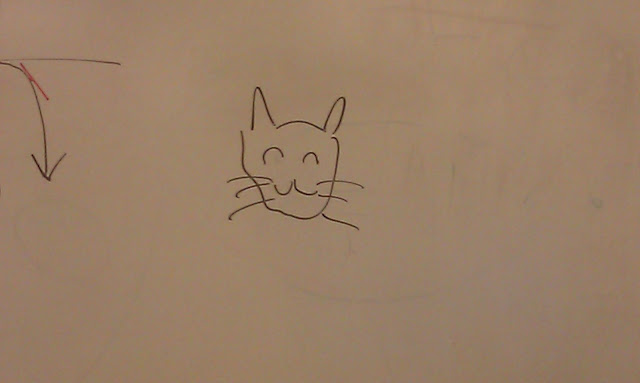 Crockett claimed that the questions on the quiz were worded in a way that did not correctly define what was supposed to be graphed, and therefore this adorable little kitty cat, which O'Brien proclaimed had "conCATvity" was a legitimate answer to the question. O'Brien did not however, agree with Crockett, and proceeded to make Crockett fight hungry lions as punishment for his drawing of kittens on the board of the mathematics room. No, I'm just kidding, Crockett didn't fight lions, but he did have to sit down in his seat.
Now we move on to the fun stuff. #mathswag
O'Brien wrote three very strange words up on the board:
Linearization
Differential
OptimizationSo, as any normal class would do when confronted with strange words, we all asked in a harmonic symphony of voices, "Mr. O'Brien, what do these strange words mean?"
Mr. O'Brien then explained to us the meaning of these odd words as thus:
Linearization is the term used for when you find the equation of a tangent line at a point, which we've had extensive practice with. O'Brien said that we're pretty gosh-darn good at this already, so we accepted the compliment and moved on.
Differentials O'Brien explained with some fancy shmancy equations that he wrote up on the board:

There's also a little graphy graph there talking a bit about both linearization and differentiation. How very kind of Mr. O'Brien.
But what about that other word on the board? What is an Optimization?
Well, what's the best way for us to be taught? EXPLORATIONS! WOO!
O'Brien gave us an exploration to do called the "Maximal Cylindar in a Cone Problem" Now, this sounds complicated and hard, but it's really not! Everything that you need to know how to figure out is right on the sheet, and the sheet does a very nice job explaining it all.

After illustrating incrediferously how to do the exploration, O'Brien helped us out with a very tricky homework problem. This problem involved a person in a row boat who wishes to return to where she came from, however, she needs to decide what's a faster way, to row there at a speed of 2mph, or row to shore, then walk there at a speed of 5mph. The answer is somewhere in-between. Now, while we may struggle to figure out this problem, there is another species that already has us beaten, O'Brien told us. Dogs. Dogs know calculus. Dogs can calculate where the best place to jump into the water in order to retrieve a tennis ball is in order to get to the ball fastest. How does it feel, classmates, to know that the canine species is better and faster at Calculus than we are? All while sprinting after a ball. I can barely walk and talk at the same time, and dogs can sprint and do Calculus simultaneously. How is this possible? Well, my friends, the answer is quite simple: Magic. Back in the days of old, the magicians of the time were meddling in the affairs of the king, and were wondering just what is it that––
No. I'm getting off track. Back to math.
Here's the picture and working that O'Brien put on the board for us.


There we go. Easy as π
Homework was:
IW #7
* p. 231/7, 10, 37a
* p. 248/5, 17, 27, 41ab, 59, 60, 62
Apparently, Mr. O'Brien's magnanimity knows no bounds. The wonderful wizard of mathematics told us he would upload to the Even Answers section of the beautifully incredible answer booklet for chapter 5.4. The class applauded, Dr. I gave everybody the day off, the government came in with large bags of money, and the President even declared December 3rd as Mr. O'Brien Day, due to the graciousness shown by Mr. O'Brien.
Aaaaaand that's all, folks. I need to get out of here before I end up writing more paragraphs about magical wizards and dogs doing calculus.
Speaking of, if you want to read a little bit more about that topic, here's an article about aMagician Mathematician who's dog is a magical calculus dog!
Yay! Calculus dogs!

-Eddie McCluskey, faithful scribe
NEW SCRIBE: Crockett Lalor.
After everybody stood up and saluted O'Brien, swearing on our sacred Calculus books that we would never again do an act so deplorable as that ever EVER again, we moved on to correcting the quiz.
Quiz problems went over in class:
1. nDeriv it! Why do more work than you have to? We're nothing but lazy high school students, and we need to act like it!
2. Double derive! At the points where y''=0 is where it changes from concave up to concave down.
3. Derive and conquer! *cough* nDeriv *cough*
4. Concavity occurs at points where p'' crosses the x-axis. function "p" is concave up when p'' is positive and it is concave down when p'' is negative.
5. Product rule and chain rule dat shindig. Once you get a super messy f '(x), then you can solve it just like O'Brien did like this:

6. Use chain rule and power rule on dat conjunction junction, what's your function? 'cept you do it TWICE. #ohmygoggles. Once you get the second derivative, you'll see where y'' will be 0, and plug in that value for x to the y equation in order to find your answer.
7. Well, well, well. This was a tricky one. So tricky, in fact, that O'Brien declared that anybody who got all three parts of number 7 correct got a 100 on their quiz! WOWZERS! He also said that anybody else who got parts of it correct received bonus points, due to the trickiness of the question...in question.
This led to a discussion as to what makes the correct answers to these problems, and O'B presented us with these answers:

Crockett-Rockett Lalor, however, did not believe that these were very correct. He was sure that he had O'Brien fooled when O'Brien asked for any volunteers to come up to the board. Crockett went up and sketched his graph here:

Now we move on to the fun stuff. #mathswag
O'Brien wrote three very strange words up on the board:
Linearization
Differential
OptimizationSo, as any normal class would do when confronted with strange words, we all asked in a harmonic symphony of voices, "Mr. O'Brien, what do these strange words mean?"
Mr. O'Brien then explained to us the meaning of these odd words as thus:
Linearization is the term used for when you find the equation of a tangent line at a point, which we've had extensive practice with. O'Brien said that we're pretty gosh-darn good at this already, so we accepted the compliment and moved on.
Differentials O'Brien explained with some fancy shmancy equations that he wrote up on the board:

There's also a little graphy graph there talking a bit about both linearization and differentiation. How very kind of Mr. O'Brien.
But what about that other word on the board? What is an Optimization?
Well, what's the best way for us to be taught? EXPLORATIONS! WOO!
O'Brien gave us an exploration to do called the "Maximal Cylindar in a Cone Problem" Now, this sounds complicated and hard, but it's really not! Everything that you need to know how to figure out is right on the sheet, and the sheet does a very nice job explaining it all.

After illustrating incrediferously how to do the exploration, O'Brien helped us out with a very tricky homework problem. This problem involved a person in a row boat who wishes to return to where she came from, however, she needs to decide what's a faster way, to row there at a speed of 2mph, or row to shore, then walk there at a speed of 5mph. The answer is somewhere in-between. Now, while we may struggle to figure out this problem, there is another species that already has us beaten, O'Brien told us. Dogs. Dogs know calculus. Dogs can calculate where the best place to jump into the water in order to retrieve a tennis ball is in order to get to the ball fastest. How does it feel, classmates, to know that the canine species is better and faster at Calculus than we are? All while sprinting after a ball. I can barely walk and talk at the same time, and dogs can sprint and do Calculus simultaneously. How is this possible? Well, my friends, the answer is quite simple: Magic. Back in the days of old, the magicians of the time were meddling in the affairs of the king, and were wondering just what is it that––
No. I'm getting off track. Back to math.
Here's the picture and working that O'Brien put on the board for us.


There we go. Easy as π
Homework was:
IW #7
* p. 231/7, 10, 37a
* p. 248/5, 17, 27, 41ab, 59, 60, 62
Apparently, Mr. O'Brien's magnanimity knows no bounds. The wonderful wizard of mathematics told us he would upload to the Even Answers section of the beautifully incredible answer booklet for chapter 5.4. The class applauded, Dr. I gave everybody the day off, the government came in with large bags of money, and the President even declared December 3rd as Mr. O'Brien Day, due to the graciousness shown by Mr. O'Brien.
Aaaaaand that's all, folks. I need to get out of here before I end up writing more paragraphs about magical wizards and dogs doing calculus.
Speaking of, if you want to read a little bit more about that topic, here's an article about a
Yay! Calculus dogs!

-Eddie McCluskey, faithful scribe
NEW SCRIBE: Crockett Lalor.
Monday, December 3, 2012
Caroline's Scribe Post
Thursday, November 29 and Friday, November 30!
To start off class, we had Unit 3 Quiz 2. Whew!! Whipping right through unit 3.
OB had two problems to start class off written on the board about......OPTIMIZATION!
What a lovely word...so optimistic and cheery! The dictionary definition means to make the best or most effective use of a situation, opportunity, or resource. Something to think of as we live our lives!
But in mathematical terms, it means to rearrange or rewrite data to improve efficiency of retrieval or processing. We will learn how to optimize our calculations to get the answer in the most effective way!
So lets get started...
Consider two numbers whose product is 50. If their sum is as large as possible what are the two numbers?
O'Brien's strategy: mathemetize it!!
We shall: let x be one #.
let y be another #.
What we know: sum = x+y
x*y = 50
What we need to do: Create a secondary equation to help solve the primary equation. Bring you back to Algebra with Seibert anyone..?
okay SO: y = 50/x
Substitute that into the primary equation.
Here is the working:

Next problem!!
Page 231/ #5
Inscribe a rectangle in an isosceles right triangle whose hypotenuse is 2 units long. What are the dimensions of the triangle with the largest area?
A beautiful diagram:
(kinda)

What we know:

You can find an equation of the line which will give you a value for y. Then, plug this value for y into the primary area equation. We know that y = (-x+1) because If you split the triangle in half, you will have two right triangles. The base of each separate triangle is 1, because the base of the entire triangle is 2. We know the height of the triangle is one because that is the rules of isosceles right triangles. Therefore, using Pythagorean theorem, you know that y = (-x+1).
Here is the working to find the area:

Then we looked at #47
The trough in the figure is to be made to the dimensions shown. Only the angle θ can be varied. What value of θ will maximize the trough's volume?

If θ can vary, what will maximize the trough's volume?
We know the formula for volume is V=A*h.
If you split apart the trapezoid, you can make the base of each triangle on the end equal to sinθ, and the height of the triangle to be cosθ. Therefore, the top of the entire trapezoid would have a length of 1+2sinθ.
If we know that, we can find the volume by multiplying the area times the height. The height is cosθ, the length is 20, and the base is 2+2sinθ.

To end class, Mr. O'Brien told us there were strategys for solving Max-Min Problems on page 223. They say this:

If you like word problems, you will like tonights IW.
IW #6: pg 231/ 5, 9, 13, 17, 20, 22, 31, 41, 47, 53, 55, 56
~~~~~~~~~~~~~~~~~~~~~~~~~~~~~~~~~~~~~~~~~~~~~~~~~~~~~~~~~~~~~~~~~~~~~~~~
Sorry for not having the scribe post up for next class.
To start off the 40 minute period class, we looked at a few problems from the text book from section 5.4, Modeling and Optimization. These were on the IW from the previous night and were questions asked on the class google doc.
#17. Designing a Can
You are designing a 1000-cm3 right circular cylindrical can whose manufacture will take waste into account. There is no waste in cutting the aluminum for the side, but the top and bottom of radius r will be cut from squares that measure 2r unites on a side. The total amount of aluminum used up by the can will therefore be:
 What is the ratio of h to r?
To start this off, we drew a picture!

To solve this, we know we have a radius, height, and area. We need to formulate a second equation which relates radius and height.
Alex came up with the perfect equation: If we are given that the area is 1000 cm3, then

Don't be afraid to check your answers in the back of the book. If you are wrong, don't give up!! Look back over what the question is asking you.
#22. Maximizing Volume
Find the dimensions of a right circular cylinder of maximum volume that can be inscribed in a sphere of radius 10 cm. What is the maximum volume?
Here is a diagram: (remember, diagrams can be very helpful because they can show you things that you did not see by just reading the problem.)

See that once we drew a diagram, you can see Pythagoras's triangle!! This sets us up to create two equations.
The first one:

And we can create a second one using Pythagorean Theorem to relate r and x.

When thinking about the physical situation, if the radius is smaller or bigger, it reaches its maximum and minimum points. As it does this, the cylinder would look like a flat pancake if the radius is at its min or a tall pencil if the radius is at its max. The most optimum volume is when the radius is in the middle!


And there you have it!
Next scribe is Eddie McCluskey. :)
Subscribe to:
Posts (Atom)