Today Mr. O'Brien began class by handing out our Unit 1 Follow-up Tests and going over the correct answers.
A note before I plunge in, I use the derivative notation f'(x) or y' instead of  or
or  , but they are just two different ways of writing the same thing. I only chose the former method because 1. I'll be honest it is easier for me 2. the latter notation belongs in physics class and 3. the latter requires latex and takes up a lot of space.
Also, I have done my best to elaborate on my scribe notes on the follow-up test, but I left my test in OB's room, and so do not have it to reference. I will update tomorrow, hopefully in the morning or during break with more insight into these problems. My apologies.
Follow-up Test
3 – a) By graphing the function, it can quickly be seen that there is a non-removable discontinuity at x=-4, and thus for the limit does not exist. But without technology, one must be careful when simplifying the radical in the denominator to take both the positive, and negative roots: (x+4) and (-x-4). This gives away that the limit has two different values depending on direction.
b) Because this is an infinite limit, we have to start by finding an end behavior model:
 (because abs(8*-inf.) = 8*inf. and -5*-inf. = 5*inf
While sometimes inputting large values into a table will get you an approximation of the value, it requires guesswork to find the exact limit. For this reason I recommend using algebra to find infinite limits, as the most difficult part is figuring out how the positives and negatives work out for polynomial and rational functions. Especially on finite limit problems, make sure to check your algebra with the table function of your calculator – it's very useful for this. Finite limits on the calculator section of a test or quiz should scream "graph and use the table!"
4 – a) Average velocity is equal to the change in position over change in time, but there was a hidden layer to this problem which may easily be missed, even if the correct answer was found. Read the next paragraph only if you feel like being picky about terminology with me (it may make more sense to students of Ms. Damian):
Position ≠ distance. Fortunately, this is not a problem for this particular problem, but if when graphing the function s(t), there was a point where the tangent line line was horizontal (∴ where s'(t)=0 and the velocity in turn =0) then it would be possible that the motion switches directions (because this is a graph of distance traveled not displacement and average velocity = displacement / time where average speed = distance / time). If the particle were not constrained to normal laws of physics, it could actually change direction one or more times where s'(t)≠0, but I think I have gone on far enough on that subject.
So assuming the particle does not change direction, let V=average velocity:
Because the question included no units, there are no units included in the final answer.
b) Mr. O'Brien found himself taking points for rounding. As preparation for the AP Calculus test, always round calculator estimations to at least three decimal places.
5 – The Intermediate Value Theorem is the one which Mr. O'Brien was after, and it says with regard to this problem that there must be a zero somewhere on the open interval (-2,-1).
6 – Cal asked whether the slope of -2 of f(x) is related to the coefficient of the exponent.
[somehow my images are freaking out by spazing around the editing page, and not loading on the blog page. <Removed>]
To explore this idea, Mr. O'Brien then graphed a second function h(x) shown below in GeoGebra, and zoomed in until the function appeared linear, with a slope of -3.
It would appear that Cal is correct!
7 – Begin by rewriting the limits to remove the discontinuities:
a) Multiply by fufoo 5x/5x
But in the original form, the limit looks a lot like the derivative definition:

Where f(x)=1/x. So the problem can be solved by taking the derivative of 1/x at x=5!
b) Factor numerator and denominator and then sub in x=5. The answer should come out to be -20
And special guest speaker, Mr. McKenzie:
"and a line segment with one endpoint closed and one endpoint open is clopen… it is not called osed because I said so." N.B.
IW #2
4) For those looking for extra credit, OB has offered it to anyone who shows how do #4 d algebraically
IW #3
p. 124
11) Find horizontal tangents of 
Horizontal tangents will have a slope of 0, so we only need to find where f'(x)=0. Using the "Damian Method",  , so just find the zeros of that function:

 Note the kissing zero at x=0 which can also be seen in the graph of the original function:
Mr. O'Brien took time to note that GeoGebra was not actually needed to sketch a reasonable graph of y, just use the zeros of the derivative to find the points where the function has horizontal tangents. These points are all local extrema or kissing zeros (@OB, are there any local extrema on this function at zero?), and if the x-intercepts are needed just take the zeros of y.
25) Find the slope of tangent line to y at x=3 of 
Similar to in 11, we start by finding the derivative using the Damian Method, and then evaluate it at x=3:
And we're done: the slope of the tangent line to y at x=3 is 11
32) Find y' where 
The easiest way we know of to find derivatives of polynomial functions is with the Oh-so-powerful power rule, but in order to use that here we must first convert the radicals in this equation to fractional powers:
Also, in order to remove the variable from the denominator of the second term, we must know that this can be done using negative powers:
Know these two totally radical power tricks, we can prep the given function for the application of the power rule:
use powerful power rule:
which as a final answer should be converted back to radicals because that is how it was given:
It might be a good idea to graph your derivative answer and the nDeriv of the original function together to make sure that they are equivalent.
In our discussion, Crockett was concerned that we had not yet proved the power rule for fractional powers, but Mr. O'Brien says we can trust him that it works, and we'll look at that proof later.
37) Find the normal line of  at (2,3)
First thing to know when approaching a problem like this is what a normal line is. The interwebs and other reliable sources say that it is the line perpendicular to the tangent line to a function at a point on that function. If the end goal is to find the equation for this line, we can do that by using point slope, since we know it will pass through (2,3), and the slop can be found once the slope of the tangent line is found. So we start with a derivative:
So the slope of the line tangent to y at (2,3) is 9. The normal line is perpendicular to the tangent, and therefore has the inverse and negative slope: -1/9
Now plugging into point-slope formula:
39) Find the points on  where the tangent line is parallel to the x-axis
Parallel to x-axis a.k.a. horizontal tangents, slopes of zero, and zeros of the derivative function.
So again, we begin with the powerful power rule:
tangents which are parallel to x-axis have slope m=0, so find where 0=6x^2 -6x -12:
The question asked for the points though, so plug 2 and -1 into the original equation:
(2,0) and (-1,27)
p. 115
40) True or False – If f has a derivative at x=a, then f is continuous at x=a.
Answer is True:
If f(x) is continuous at x=a, then f(x)=f(a) as x approaches a
Prove:
It also makes sense when you think about different discontinuities and whether there is a way to draw a tangent line at them. I find it easier to understand it this way, but proofs are a necessary part of math class…
–––––––––––––––––––––––––––––––––––––––––––––––––––––
On to new concepts!
On to new stuff:
Product Rule (for derivatives)
We began by looking at the first question on the IW for tonight, exploring predictions of what p'(x) is if p(x)=f(x)*g(x). Unfortunately, p'(x)≠f'(x)*g'(x), but rather:
Testing:
Find derivative of 
Plugging the derivative as dictated by this rule into calculator "y=" function:
and
graphing, we can see that they are indeed equivalent!
Let 
Prove 
irregardlessly,
with a fufoz:
For those think a mnemonic device would help in remembrance, I found this on wikipedia:
"Hi dee lo plus lo dee high"
In this, "lo dee hi" means take the low (denominator) function and multiply by the derivative of the high (numerator) function. The order of terms doesn't matter in this rule though, because of the commutative properties of addition and multiplication, so the mnemonic shouldn't be needed for too long, and it may cause confusion when trying to memorize the quotient rule mnemonic (see below).
Quotient Rule (for derivatives):
Where
Notice that the quotient rule, unlike the product rule includes a fraction (makes sense right?), but remembering which function goes where and where each derivative goes seems a little hard to memorize. I think about it as follows:
• The denominator of the derivative fraction is the square of the normal fraction
• The denominator of the normal fraction belongs as a factor in the first term of the numerator
• From there, the numerator is like the product rule, except subtract rather than add
For those think a mnemonic device would help in remembrance, I found this on wikipedia:
"If the Quotient Rule you wish to know -- It's lo dee hi less hi dee lo -- draw a line and down below, the denominator squared must go."
I think this is probably the one Mr. O'Brien's friend used. "lo dee hi" means take the low (denominator) function and multiply by the derivative of the high (numerator) function, and "less" stands for subtract. Unfortunately, this mnemonic device uses the same nonsensical words as the product rule for the important part (that is, the numerator), just in a different order. I would recommend getting the product rule down pat if you want to use the mnemonics for the quotient rule.
Further reading (provided by strangers on the internet):
Quotient Rule (also includes an extension of the rule to the second derivative at the top, among all sorts of nerdy stuff further down)
Bonus:
40min period:
Today we started by going over a few problems about finding derivatives with the power rule. If you still have trouble with this, Willis' post covers the nitty gritty details, and I would recommend rereading that. Then we went over a few problems in which the the Product Rule can be used.
Sarah asked: "why is the product rule helpful; when is it easier to use?"
Answer: When we begin factoring out more complicated functions like trig functions, it will help more than it does now. For polynomial functions, it's often easier to just use the power rule, and for some rational functions, to convert to polynomial functions using fractional powers and use that power rule. ex. Finding derivative of something like (x^2+3)/x becomes x+3x^(-1), power rule says the derivative is x-3x^(-2)
The quotient rule on the other hand is more applicable when we're dealing with rational functions which cannot be turned into polynomial functions. For example, IW #4 asks us to take derivative of x/(x+1).
Rule of Thumb: Reduce before you take the derivative if you can. It will save a lot of work!
Next Scribe is Gabe
UPDATE:
I found this thought provoking (and humorous) write-up about the calculation of irrationals in binary. But near the end, the author implies that the majority of real numbers are irrational, which seems like quite a claim. Thoughts? And how does this relate to our "discontinuous at every point" functions? Also, the conclusion makes it just that much better.
Duncan out

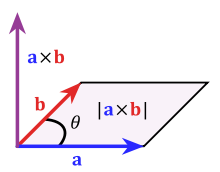 But what is the formula for the areas of these parallelograms, you might ask. This is where it gets a little bit tricky. Turns out, that there is a handy formula for the areas of these shapes, but it gets into vector math, which can be a bit confusing at first. The area of a parallelogram can be expressed as the magnitude of the cross product of the vectors (lets call them a and b) which make up two of its adjacent sides:


![f'(x) = \frac{g'(x)h(x) - g(x)h'(x)}{[h(x)]^2}.](https://lh3.googleusercontent.com/blogger_img_proxy/AEn0k_vte3SSuQ3iGcempSeQ6X7swJHKjEemLqabyEqvvfmmAdDb-YBad6yqQ3MItl7qxmWr_WdjKTih3900JzOI2qknDsWnG6y7RiLnPtyNd7JIrCRVnQKxmmuZes_j7s10inS-QUJZAkmUQqBvUadj=s0-d)