Showing posts with label Coleson. Show all posts

Wednesday, May 29, 2013

Surfaces of Revolution

Surfaces of Revolution
Measuring the Enigma

Surface area really is tricky. Volume, as we know, can be measured using liquid. An interesting aside, Archimedes originally discovered this principle while taking a bath, and he subsequently ran through the streets naked shouting about it (you can learn all about that story here). Measuring length is a similarly simple process: take a string, match the curve, and the measure the string. Easy. Surface area, however, is different. Certainly, surface area is simple enough to find on prisms, and they have flat sides, but once curves are involved the process becomes more difficult. (the video I showed a part of during the presentation)


Take this torus for example. The surface area of this object could be measured by calculating the surface area of each individual square on the surface on this torus. However, it would not be all that accurate. But what if we called the surface area of these squares as representative rectangles? What if their size was our change in x? If that was the case, we could set up a limit as the size decreases towards 1/∞ that acts on a summation of all the surface areas. This limit would give us an approximation of the surface area (seen below).


However, this equation is only useful as a model of an idea. It is not really feasible, at least at our level of mathematics. For this reason, we will think about surface area in terms of circumferences. 


Just as each representative radius led us to the area when finding the volume of a surface of revolution (below), that same radius begs us to use circumference when finding surface area.

VOLUME                                         SURFACE AREA
  

The surface area method sums up the surface area of the sides of our beloved representative rectangles. For this reason, it is important to pay attention to the shape of these surfaces of revolution as each limit is approached. If the surface of revolution animation above, there are two small disks at either end. Those disks both have their own surface area, so their area must be individually calculated. If we say that r(x) is the radius function, then the Surface Area integral evolves to look more like this:


But this isn't all. Consider, for instance, the function below. This function has both an exterior surface (y=√x) and an interior surface (y=x/10).


Due to this, the integral must change again, along with some of it's notation. Let rbig(x) be the exterior radius, and rsmall(x) be the interior radius. I will leave r(a) in the equation, even though r(a)=0 for this particular problem set. If we think about it, we must then sum both the interior and exterior surfaces, along with the area of the two washer at each end. 

***NOTE: there are now washers instead of disks are each end. This change occurred because of the switch from one function being revolved to two functions being revolved. Now we must use washers to find the difference between the larger and smaller circles.***

       LEFT WASHER              RIGHT WASHER              EXTERIOR SA              INTERIOR SA

Of course, this notation makes everything look a bit more complicated that it needs to be, but it gets the point across. So now let's try this method out for the last video.

We are revolving the area between f(x)=√x and g(x)=x/10 on the interval x=[0,4] about the x-axis. We know that there will be no washer on the left side, as both f and g are equal to zero when x=0. So our initial equation looks like this:


But wait, the second surface [with g(x)] is just a cone, isn't it? An angled line? Yes, it is! So we can use the SA formula for the side of the cone (SA=πrl) instead of the crazy integral mess.


Now that is better. One integral, a couple functions appraised at single values. No problem. Slap that into the calculation (good old fnInt), and … SHAZAM!

That whole mess is equal to ~50.600587.

You are a genius. Go do your happy dance, then try the quiz.

The Quiz

Thanks!
Cole

p.s. Duncan values SATs more than a day in O'Brien's classroom. Let us collectively dishonor him.

More math animations here

Quiz answers (be honest, no one is grading you)

Tuesday, March 5, 2013

Scribe Post 5-8 March

Knowing that the class was to begin with a thrilling Supercorrection Follow-up Test, all students merrily frolicked into room 219 as Crockett played "Concerning Hobbits." This joyful tune made many a happy face on this fateful day of integration. Proceeding with gusto, the class delved into the test from 33 minutes past the hour of nine until time ran out 13 minutes after ten o'clock. The scribe post of the exceptionally affluent and widely respected Sir William Billiam Shilliam Dilliam Strongclaw Proudfoot Covenhoven III (seen below) was then thoroughly analyzed and appreciated before moving on to the topic at hand: Integration by Substitution.

His Eminence Sir William

Task 1: Solve the following


a. long division


b. substitution


BREAK
Apparently there was not supposed to be a scribe post for Tuesday or Wednesday, so we will continue on Thursday.

If you are having trouble with Integration by Substitution when you change the limits of the integral from terms of x to terms of u, check out this video. It particularly helps with IW#1, problems 54, 55, 59, and 71.

THURSDAY:

Today we began by reminding the whole class to sign up for their AP Calculus Exam. If you forget how to, you can go to the guidance office to figure that ish out.

Supercorrection follow-up tests came back in after that. Our class continues to improve on these tests each time! We proceeded to go over the answers to each question

1. Physics bums need to remember the superiority of radians.
2. Trapezoid Rule (remember area of a trapezoid)
                  
The two bases are actually two heights in this problem set, and the height is correspondent to the width of each trapezoid.

3. Remember to divide the integral by the interval to get the average value.

4. a. nDeriv(v(t))
4. b. total distance: 
The absolute value sign accounts for areas between the curve and x axis that are negative (when the curve dips below the x axis).
4. c. Fundamental Theorem of Calculus: 
           In the problem set: a = 0, b = 5, x(0) = 4
           So,


5. Check your answer by deriving! If it didn't work, then try to figure out what was missing.

6. Any integral of an exponential function with base e will always include e raised to the original power in the answer. This can provide a good starting point for these problems. By taking the derivative of the integrand, you can identify which constants are necessary to transform the function into the integral.

7. Graph it!

8. Split apart the integral by Addition Rule and integrate!

9. a. Zero Rule of Integration
9. b. Order of Integration
9. c. Odd functions are symmetrical about the origin
9. d. Addition/Subtraction of Integrals

END OF SUPERCORRECTION REVIEW

THE FINAL PROBLEM!

Area bounded by two curves?
Not all math is nice, some is sketchy.
Area_G1


2000 AP Calculus Question 1

a. As a Sum of Rectangles, and, by extension, and integral
     choose a base (a change in x)
     then find your heights (height of upper function-height of lower function <= always positive)
          ^difference between two functions
      set up your integral (upper function - lower function <= this changes depending on interval)
            
        k = point of intersection, so the point where  (Solver, then integrate)

Small Break:

   Golden Way: Finding area between any two curves
      
          ^ensures that the height will always be positive
   If there are three curves => you need multiple integrals

b. The volume of the solid when revolved around the x axis? What?!
      1. Take representative rectangle (selection from area btw curves)
      2. Revolve around axis to create washer/ CD shape.
      3. find the area and then the volume.
  Area of two concentric circles = area of larger - area of smaller
  So, since the base e function is larger than the cosine function, and area of a circle = πr^2
           
This is advanced stuff though, we will cover it in more detail later. Feel no obligation to understand this at this juncture. We will ease into it.

IW#3 p. 399/ 2, 4, 10, 14

2. area btw


4. area between two vertical (think horizontal rectangles)


            = 4/3 or 1.33333....

10. 
     Watch out, you can solve for x or y on this one!
          
          The second integral in the second one is just a right triangle, so use Pythagorus!
          Answer: 0.83333333....

This area work can be tricky, but is is the exact same process as finding the combined area of two curves. The only difference is that we are using subtraction instead of addition. If you are still confused, then ask Patrick JMT. Visual Calculus does a great job showing step-by-step solutions to a number of "area between two curves" problems.

14. space between
       
First: Determine dx or dy formula (think about the rectangles => vertical vs. horizontal)
          
Without tech: find intersections and integrate with smaller function subtracted from the larger.
        Intersections: (-1, 3) and (2,0)


p. 401/ 49


Find the intersections:

x = 0.8241323....

Set up the integral:


Next scribe will be Gabe (Eddie dropped out).

Saturday, November 3, 2012

Why I take AP Calculus

Mr. O'Brien's 2012 AP Calculus Class,

We have all come a long way since we took a class which taught us arithmetic.
Algebra I, Algebra II, and Geometry are things of the distant past.
Last year, we learned some essential rules of mathematics.
This year, we have used these rules to evaluate limits.
We have worked with differential equations.
We have persevered through complex proofs.
Now we have seen real math.

We will continue to discover.
We will continue to learn.
Math does not end.

I take AP Calculus for the epiphanies.
When a concept finally makes sense
I experience a "math-gasm."
That is why I love math.
Even when a concept confounds,
Questions can open doors;
A friend can offer an explanation,
And understanding can be reached.

I hope you are of the same mentality,
Cole

Thursday, September 20, 2012

Scribe Post 9/20

As Crockett decided not to come to class today, I, Cole, have volunteered to take his place as scribe.

We began class today with an exploration worksheet of a piecewise function, seen below.


The first question examined f(x) when k=1. We were told to sketch the graph which should look like the image below.


The discontinuity seen at x=2 will be noticed as a jump discontinuity, when k=1. We then sought to determine the positive and negative limits of f(x) as x approaches 2, seen below.


As we have learned earlier, for a function to be continuous at a point, both of the single-sided limits must equal the value of f(x) at the x values which the limits approach.  As the right limit is influenced by k, and the right limit was three times the value of the left limit, we reasoned that a k value of 1/3 would make the two limits approach the same value of 3 as x approaches two.  When we implemented this hypothesis, we discovered that a k value of 1/3 did indeed make the function continuous at x=2.  However, the function was still not locally linear at x=2, as there was a cusp at that value.  A cusp, derived from the Latin cuspis - "point or apex," is the pointed meeting of two curves, seen below.


Once we had defined what a cusp was, we transitioned to looking over the Quiz.  Two free points were given to account for small mistakes.  The first four questions were simple limit questions which relied on factoring polynomials and finding clever ways to obtain the GOLDEN LIMIT (below)


Number two (below) was a little bit tricky, but if we remember the relationship between sin(x)/x and sin(2x)/x, then the expression can be simplified to a slope over slope relationship, 3/7.  If limits are still a problem, the rules of limits can be found here or on page 61 of our textbook.


We continued through, pausing at both five and six, which questioned our knowledge of the properties of limits and the classification of different discontinuities.  These principles can be found right after the fire drill in Scotty's scribe post.  Seven and eight were not too eventful, and the Bonus was shown to be simple after a little bit of working (shown below).


After we finished the quiz, we moved on to IW #7, starting with four (below).


When we graphed this function, we observed that x^2 was approaching 0 at twice the rate that 1-cos(x) was approaching zero.  Therefore, the limit was equal to 1/2.  An algebraic solution to this equation can be seen below.


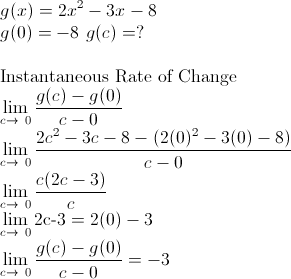
Skipping over five, six, and seven, we moved on to eight and examined Instantaneous Rate of Change. The first part of eight asked us to find average rate of change, or slope, which is a rudimentary mathematical working which will not be gracing this post with its presence.  However, we were then asked to find the rate of change at a point.  This is done in a similar way to finding average rate of change, but its results are mich more useful.  If we take the function g(x) and appraise it at two points, (0, g(0)) and (c,g(c)), and evaluate the limit as c approaches zero, we will find the Instantaneous Rate of Change.


How to find Derivatives

Limit Definition
Local Linearity (seen above with g(c) and g(0))
nDeriv(function, x, point) - on Graphic Calculator under the MATH menu
WolframAlpha
g'(2) on GeoGebra

The following is the "Ms. Damian Way" of finding limits.

Consider: v=t^2
Acceleration (Instantaneous Rate of Change): a=v'=2t
The following is the proof for this way of finding derivatives.


NOTE: The Ms. Damian Way does not play nicely with natural logarithms or trigonometric functions, it only likes power (polynomial) functions.  Here is a great video that goes through this process step by step and gives a formula to find the derivative of a function (below).


NOTE: The notation (dy)/(dx) is what is used to show that you are taking the derivative of a function. You may notice that it is similar to (∆y)/(∆x), which we used to show average rate of change.  As the derivative shows instantaneous rate of change, it requires its own notation.

If the concept of instantaneous rate of change is still a little hazy, this interactive applet may be helpful.  It evaluates the derivative and a secant of a parabolic, exponential, and hyperbolic equation as well as that of a sine curve.  If you are confounded by the applet, which takes a little bit of examination to understand, then you can read this post on M∆th Sc∞p which does a very good job of differentiating between secant and tangent lines and their application to derivatives.

UPDATE: Now, we no longer need any of these rules to differentiate equations.  After IWs 10, and 11, we can tackle any functions involving trig, inverse trig, exponential, or logarithmic functions. For example, even this monster (below) can now be solved using the rules we have learned.


Although we can solve this, after a few steps, it becomes rather insane, so it is much easier to use tech to solve this problem.  nDeriv(f(x), x, any x value) can evaluate this function at any point.  Even though it does not yield a function equation, it can tell us what the derivative is of that monster at a point.  For example, when x=3 is ~35362601.44.  Although it doesn't tell us anything about the graph, and shouldn't be relied on to find derivatives, nDeriv can be useful in evaluating complex derivatives at singular points.

END OF UPDATE

To finish off class, we received a practice version of a Finely Crafted Opportunity Day, which will serve as our eighth assignment.  As many of our classmates will not be here friday, due to the very exciting Common Ground Fair, we are now on our own for studying for the TEST ON MONDAY.  Although we will be going over parts of the practice test on friday, as it is own independent work.

When we went over the practice test, a number of questions were focused on.  The main skills that the problems focused on were the ability to simplify a limit by factoring and using conjugate FUFOO's, and the ability to graph a function based on a set of parameters involving single- and double-sided limits.  Remember to look for the small negative signs on limits, as they are easy to miss.

As an aside, here is a google doc that I have created which contains helpful LaTex formulas for weird functions.  Anyone can edit and add formulas, so please contribute with your own formulas.  Here is a website that also has a number of helpful LaTex function formulas.

THE NEXT SCRIBE WILL STILL BE CROCKETT
(If he has the audacity to show up to class on Wednesday...)

One final thing, I found a cool animation of the instantaneous rate of change, or slope of a point, on a curve and thought I might add it in at the end.  It plots slope over x values, which creates an interesting curve.

UPDATE: We now know that this animation is plotting the derivative of a function with a high power of at least x^4.  The line that moves on the function is tangent to the function, so its slope is the instantaneous rate of change of the blue function.