 Bluester began the period with an exciting look at what's next! (Un)fortunately, we are almost done with new material, something that should be a relief but also tragic and somewhat nostalgic for us hardcore AP Calculus nerds. All we've got left is Unit 5 and 6 (review) which means a lot more extremely stressful IW's and our last finely crafted opportunity day! In a quick blast to the past, I hope you all got your Unit 4 SuperCorrections in to OB on Friday! This coming Tuesday holds the daunting, equally-weighted follow-up test, which is a chance to shine or realize you never understood the unit! Then the Bluester Cluester showed us a divine sneak peek at the AP Calculus Bible, a sneaky book of everything we need to get a 5! It had things like:
-Limits
-Asymptotes
-Continuity
-Derivatives as functions
-Concept of derivatives
-Derivative at points
-Slope of curves at a point
-Local linearity
-Applications of derivatives
-Computation of derivatives
-Definite integrals
and LOTS more!!!!!
If you didn't remember a lot of those things, its time to review! Luckily, we are going to have a lot of time to do so and we will be using the wonderful Khan Academy to aid us! Bluester's goal is for everyone to get at least a 3, and it IS possible! Khan Academy is really cool. We took a quick look at this link: https://www.khanacademy.org/math/calculus/differential-calculus/differential-calculus/e
It was really cool and our answers and progress could all be monitored just as if Bluester was Big Brother! We will be using Khan Academy more so here's the link to the site itself, for your personal gain: https://www.khanacademy.org/math/calculus/
Then, we saw a new sneaky bullet point on the list that was completely NEW!!!
"Antiderivatives by substitution of variables"
<- that's today's class, SURPRISE!
But for now, O'Brien decided to deviously delay the lesson and return to Caroline's scribe post!
We set up a GeoGebra sketch. First, we made slider "a" and set it equal to 1.
Then, we created f(x) = x^2
Finally, we created A, a point (x,0) somewhere on the x-axis. Then we took the integral, using the GeoGebra integral template to fill in function (f) and boundaries (a, x(A)). At this point, it looked a little like this.

Finally, we plotted (x(A), b) as point B, and turned on trace for B. The traced line looked like a function! In fact, it looked a lot like a cubic function, which Becca intuitively pointed out to be the function:


Well well well. That function was actually AN antiderivative of the earlier function f(x). It wasn't THE antiderivative because antiderivatives can be plentiful due to that constant "C," the tricky reason why many of us screwed up that antiderivative question on the Unit 4 Test. So yeah, this was pretty cool.
BUT DOES IT WORK WITH OTHER FUNCTIONS????????
We changed f(x) to equal sin(x). With trace, things looked a little like this:

Wowzer! It worked again, somebody correctly answered that the trend we were seeing was the function:

We checked that it was an antiderivative, and it was. Another interesting to note was that in the function, the 1 in the cos(1) really was the variable a, and it was a constant translation for the function as we moved slider "a."
Alrighty, next up on "Guess That Antiderivative Function" was ln(x):

Yippee! Three for three! The antiderivative of ln(x) was the function:

Some interesting things to take into consideration. First, Bluester realized that we needed to change the function to ln(t) instead of ln(x) because x was a variable with different representation. Second, it worked! The function was an antiderivative function. We continued to prove that the lower limit of the integral (represented with a 1) can be changed with the slider for that variable "a." When changed it always alters the constant of the function.
----------------------------------------------------------------------------------------------------------------------------------
Here OB began to shift directions. He showed that due to the FUNDAMENTAL THEOREM OF CALCULUS, the following is true:

But how do we know that xln(x) has a derivative of just plain ln(x)?
Well this is how:

In short, OB says "you gotta know your derivatives to do antiderivatives!"
Then OB showed us why there is a constant in the first place! It's just like trying to find integrals when you evaluate a function's antiderivative at each end of an interval and find the difference. The constant must be subtracted at the end. Here's a more elaborate explanation from OB:

You can see that -(2ln(2)-2) is the antiderivative evaluated at 2, the lower end of the interval in this case. That's an exciting new way to find constant C! We moved on.
----------------------------------------------------------------------------------------------------------------------------------
The wily Bluester Cluester decided to set up a new learning springboard:


Does it matter whether, in the integral, policy is f(x) or f(u)? dx or du?
YES, it DOES!
We proved this by testing the functionality of three different looking integrals.

You can see that for part a, the antiderivative of the original function was taken to get an answer. On part b, we used f(u) and du instead of f(x) and dx. The process was rather similar until we substituted u's back for x's again at the end and found that the answer was different! Finally, on part c, with a little hybrid equation, we had to substitute in x's at an earlier step, but got an entirely new answer. Overall, Bluester made it clear that IT MATTERS!!!!
----------------------------------------------------------------------------------------------------------------------------------
Now lets use the function:

What's the antiderivative? Ummmmm....
While everyone sits in discombobulation, crafty Connor immediately goes to Wolfram Alpha!
The answer is this:

What the heck? Where did THAT come from? Suddenly, Alex Wilder has a moment of true revelation and says, "It all makes sense!"
Taking the derivative of that craziness proves the insanity! See:

Amazing! This leads O'Brien into a frenzy, it is finally time to learn the main idea of the day, "Integration by Substitution."
----------------------------------------------------------------------------------------------------------------------------------
We started out with the same function tan(x).
Then we took some new steps:
1. Discovered we could rewrite tan(x) as sin(x)/cos(x).
2. Allowed u (the substitution variable) to equal cos(x).
3. This meant the derivative of u was equal to -sin(x).
4. -sin(x)dx ended up being equal to du, so we can sub in du if we can find one of those.
5. We found one of those by adding a -1/-1 fufoo!
6. We arrived at an easy function to work with, we anti-differentiated.
7. We substituted x back in for u and got the crazy answer that before could only be done on Wolfram!
Here is a picture of our work:

Well that was new and exciting! Bluester wanted us to practice so we decided to tackle a few questions from the IW (that you should all be working on about now).
First up, was #32!
We started with a really nasty looking thing but using the steps above came up with a much easier function to anti-differentiate. Yay! The work is below:

Next up, we moved on to #34. Again, things looked dire, but we used Bluester's step by step procedure and prevailed handsomely! I popped the question to OB, "Don't things have to just be perfect for this type of thing to work out?" OB responded, "Yes, it's rare that things will be as nice as they are in these book problems, so this technique might have little real world practical use." But let's be real. You're a student in AP Calculus. When will any of this stuff have "real world practical applications?"

Finally, we moved onto the last problem which OB scrawled out just before announcement time!
The work for #45 is below:

So that was some good practice using the substitution techniques! Keep working on more to master the skill! Also, if you want some help from an MIT professor, check out this youtube video, suggested to watch on your own time due to length: http://www.youtube.com/watch?v=W7sNkRpcydk
OB also reminded us of some sneaky tricks to help us on substitution problems like these:
1. Remember Fufoos! They can come in common to make things work nicely!
2. Substitute in du, get rid of all x's in the problem before anti-differentiating.
That's it folks!
Announcements...
Half Period Notes:
We didn't even look at my scribe post :( :( :( :( :( :( :( :(
OB came in and jumped right into the Unit 4 test answers!
The first question could just be done with fnInt.
The second question was a trapezoid rule, a lot of people just took an underestimate, but we learned how to do things the right way. (picture and working to come)
The third question we discussed during SuperCorrection days, it was about the pizza!
The fourth question we needed to find the integral (picture and working to come)
The fifth question was a big old free response. Part a was found using fnInt, (but don't write that!) Part b was as simple as writing down the definite interval and taking the absolute value of that velocity. For part c, we needed to add it to the starting position and not use absolute value.
The sixth question was all about mean value theorem and Riemann sums! You had to be able to interpret the intervals and get average acceleration. Then, you could use things like symmetric difference quotient to get part c! On part d, you had to be able to interpret the unit of the definite integral.
The seventh question was a function with different regions. You also had to be able to interpret the addition of constants to an integral.
The eight question made us find the derivative/antiderivative to find that g prime and f prime were both ln(x). Then, you had to explain that it was a translation.
The ninth question made us test whether Riemann sums and Trapezoidal sums were underestimates or overestimates of different function graphs.
The tenth question was just the antiderivative, but because of chain rule, it was D.
The eleventh question required absolute value signs around the 3-x in ln(3-x). Part b was more antiderivatives.
The twelfth question was again an evaluation of an integral with some anti-differentiation.
The thirteenth question was best found with a graph that allowed us to see the absolute value function shifted over. Then the definite integral can be taken from that.
The fourteenth question was a test of our knowledge for properties and rules of integrals (like zero rule!)
The fifteenth question made us solve for k, which could be found by getting an antiderivative and then evaluating.
The sixteenth question tested our knowledge of slope fields, which was tricky for some, also we had to perform separation of variables and anti-differentiation to solve for f(x)
Nobody had any questions, but you better study up for tomorrow's test!
Then we went over question 48 and question 54 from the IW.
Pictures will be coming with more details of the work on these problems! (as soon as I can offload them from my phone!)
Cole Ellison is next scribe. (The sneaky boy who was supposed to be scribe a while ago and somehow slinked his way out of the devious duty.)


 . It's so simple! Math really is easy!
 . Could this be true? Let's backtrack - if we take the derivative of this function by multiplying by the power of the cubed x and dropping it by one, we get . Success! Does the function go through (2,4)?
  , it checks out! Once again, Duncan amazed us all with his math expertise.
 in it, so that when the power is multiplied in front and dropped, we wind up with an x squared.
  . But that's not right! There must be something added to this equation we're finding; something that, when derived, drops out. Something like a constant - lets call it c.
  . Now this is looking better! What, when added to
  , makes 4? Why,
  of course! It seems we found our c! From there, its as simple as putting together the parts and coming up with Duncan's
  . What is our f(x)? Working backwards, we antiderive (fancy word) that, in order to get sin(x) as a derivative, we must have started with
  . It only makes sense - since the derivative of cos(x) = -sin(x), this function would give us the desired derivative. But let's step up the math. Take a look at this example:
 ? Lets remember our definition of the derivative of inverse tan that we all obviously remembered perfectly on the followup!
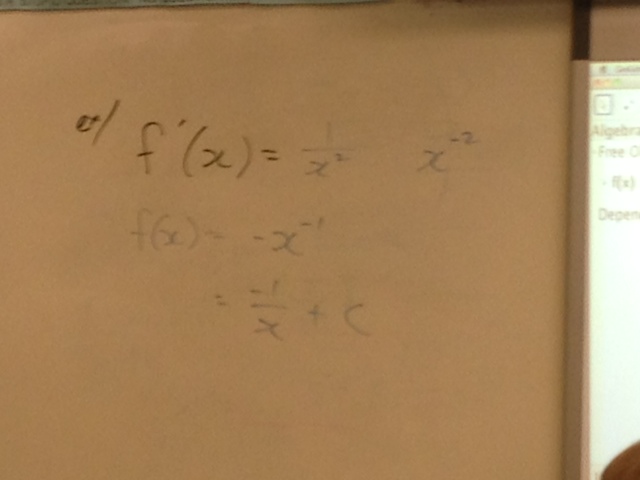
 . Using the knowledge Duncan showed so excellently in our first example, lets examine what our function should look like! To get a final value of
  fits well! Dropping down a negative one will make the derivative positive, and the power will descend to -2! But we know that a negative powers moves our x to the bottom of the fraction, leaving the -1 on top. Don't forget that there might be a constant c!
 is
is  . In this case, the thing on the bottom of the fraction is an
  . Thus, we know that it must be what was initially natural log'd. Don't forget that constant c! Work backwards from the f(x) we found above if you're still confused - you'll see that taking its derivative works out. Oh wait... does it? When you bring the power out front, that function becomes
  . Its derivative wouldn't be what we're looking for, it would be
  , not
, not  like we wanted! Oh woe and sadness, whatever will we do? We could try dividing by 2...

 . Thus, using the product rule we know that
  . However, this is as far as we can go. There is only one antiderivative that can be found per equation, they are unique.


