Here is the ThatQuiz link:
Period 2
Period 4
Your ThatQuiz score is automagically sent to me.
Here is the Quizlet link.
You will need to to show me your Quizlet score.
Showing posts with label quiz. Show all posts
Showing posts with label quiz. Show all posts
Friday, April 5, 2013

Tuesday, December 4, 2012
Scribe Post 12/3
We began our beautifully wonderful mathematics experience on this fine day by going over the Unit 3 Quiz #2. Before we looked at the quiz, however, O'Brien informed our class that many of his Calculus students (our class especially) have been putting off the homework, and therefore many more people did less than excellently on the quiz. :( He also informed us that a mere one singular person passed in their IW 1-5 packet on time. Shame on us. :'(
After everybody stood up and saluted O'Brien, swearing on our sacred Calculus books that we would never again do an act so deplorable as that ever EVER again, we moved on to correcting the quiz.
Quiz problems went over in class:
1. nDeriv it! Why do more work than you have to? We're nothing but lazy high school students, and we need to act like it!
2. Double derive! At the points where y''=0 is where it changes from concave up to concave down.
3. Derive and conquer! *cough* nDeriv *cough*
4. Concavity occurs at points where p'' crosses the x-axis. function "p" is concave up when p'' is positive and it is concave down when p'' is negative.
5. Product rule and chain rule dat shindig. Once you get a super messy f '(x), then you can solve it just like O'Brien did like this:
 Voilá! it's beautiful!
6. Use chain rule and power rule on dat conjunction junction, what's your function? 'cept you do it TWICE. #ohmygoggles. Once you get the second derivative, you'll see where y'' will be 0, and plug in that value for x to the y equation in order to find your answer.
7. Well, well, well. This was a tricky one. So tricky, in fact, that O'Brien declared that anybody who got all three parts of number 7 correct got a 100 on their quiz! WOWZERS! He also said that anybody else who got parts of it correct received bonus points, due to the trickiness of the question...in question.
This led to a discussion as to what makes the correct answers to these problems, and O'B presented us with these answers:

Crockett-Rockett Lalor, however, did not believe that these were very correct. He was sure that he had O'Brien fooled when O'Brien asked for any volunteers to come up to the board. Crockett went up and sketched his graph here:
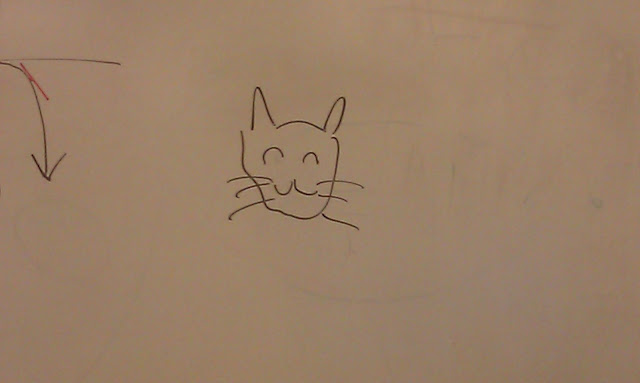 Crockett claimed that the questions on the quiz were worded in a way that did not correctly define what was supposed to be graphed, and therefore this adorable little kitty cat, which O'Brien proclaimed had "conCATvity" was a legitimate answer to the question. O'Brien did not however, agree with Crockett, and proceeded to make Crockett fight hungry lions as punishment for his drawing of kittens on the board of the mathematics room. No, I'm just kidding, Crockett didn't fight lions, but he did have to sit down in his seat.
Now we move on to the fun stuff. #mathswag
O'Brien wrote three very strange words up on the board:
Linearization
Differential
OptimizationSo, as any normal class would do when confronted with strange words, we all asked in a harmonic symphony of voices, "Mr. O'Brien, what do these strange words mean?"
Mr. O'Brien then explained to us the meaning of these odd words as thus:
Linearization is the term used for when you find the equation of a tangent line at a point, which we've had extensive practice with. O'Brien said that we're pretty gosh-darn good at this already, so we accepted the compliment and moved on.
Differentials O'Brien explained with some fancy shmancy equations that he wrote up on the board:

There's also a little graphy graph there talking a bit about both linearization and differentiation. How very kind of Mr. O'Brien.
But what about that other word on the board? What is an Optimization?
Well, what's the best way for us to be taught? EXPLORATIONS! WOO!
O'Brien gave us an exploration to do called the "Maximal Cylindar in a Cone Problem" Now, this sounds complicated and hard, but it's really not! Everything that you need to know how to figure out is right on the sheet, and the sheet does a very nice job explaining it all.

After illustrating incrediferously how to do the exploration, O'Brien helped us out with a very tricky homework problem. This problem involved a person in a row boat who wishes to return to where she came from, however, she needs to decide what's a faster way, to row there at a speed of 2mph, or row to shore, then walk there at a speed of 5mph. The answer is somewhere in-between. Now, while we may struggle to figure out this problem, there is another species that already has us beaten, O'Brien told us. Dogs. Dogs know calculus. Dogs can calculate where the best place to jump into the water in order to retrieve a tennis ball is in order to get to the ball fastest. How does it feel, classmates, to know that the canine species is better and faster at Calculus than we are? All while sprinting after a ball. I can barely walk and talk at the same time, and dogs can sprint and do Calculus simultaneously. How is this possible? Well, my friends, the answer is quite simple: Magic. Back in the days of old, the magicians of the time were meddling in the affairs of the king, and were wondering just what is it that––
No. I'm getting off track. Back to math.
Here's the picture and working that O'Brien put on the board for us.


There we go. Easy as π
Homework was:
IW #7
* p. 231/7, 10, 37a
* p. 248/5, 17, 27, 41ab, 59, 60, 62
Apparently, Mr. O'Brien's magnanimity knows no bounds. The wonderful wizard of mathematics told us he would upload to the Even Answers section of the beautifully incredible answer booklet for chapter 5.4. The class applauded, Dr. I gave everybody the day off, the government came in with large bags of money, and the President even declared December 3rd as Mr. O'Brien Day, due to the graciousness shown by Mr. O'Brien.
Aaaaaand that's all, folks. I need to get out of here before I end up writing more paragraphs about magical wizards and dogs doing calculus.
Speaking of, if you want to read a little bit more about that topic, here's an article about aMagician Mathematician who's dog is a magical calculus dog!
Yay! Calculus dogs!

-Eddie McCluskey, faithful scribe
NEW SCRIBE: Crockett Lalor.
After everybody stood up and saluted O'Brien, swearing on our sacred Calculus books that we would never again do an act so deplorable as that ever EVER again, we moved on to correcting the quiz.
Quiz problems went over in class:
1. nDeriv it! Why do more work than you have to? We're nothing but lazy high school students, and we need to act like it!
2. Double derive! At the points where y''=0 is where it changes from concave up to concave down.
3. Derive and conquer! *cough* nDeriv *cough*
4. Concavity occurs at points where p'' crosses the x-axis. function "p" is concave up when p'' is positive and it is concave down when p'' is negative.
5. Product rule and chain rule dat shindig. Once you get a super messy f '(x), then you can solve it just like O'Brien did like this:

6. Use chain rule and power rule on dat conjunction junction, what's your function? 'cept you do it TWICE. #ohmygoggles. Once you get the second derivative, you'll see where y'' will be 0, and plug in that value for x to the y equation in order to find your answer.
7. Well, well, well. This was a tricky one. So tricky, in fact, that O'Brien declared that anybody who got all three parts of number 7 correct got a 100 on their quiz! WOWZERS! He also said that anybody else who got parts of it correct received bonus points, due to the trickiness of the question...in question.
This led to a discussion as to what makes the correct answers to these problems, and O'B presented us with these answers:

Crockett-Rockett Lalor, however, did not believe that these were very correct. He was sure that he had O'Brien fooled when O'Brien asked for any volunteers to come up to the board. Crockett went up and sketched his graph here:

Now we move on to the fun stuff. #mathswag
O'Brien wrote three very strange words up on the board:
Linearization
Differential
OptimizationSo, as any normal class would do when confronted with strange words, we all asked in a harmonic symphony of voices, "Mr. O'Brien, what do these strange words mean?"
Mr. O'Brien then explained to us the meaning of these odd words as thus:
Linearization is the term used for when you find the equation of a tangent line at a point, which we've had extensive practice with. O'Brien said that we're pretty gosh-darn good at this already, so we accepted the compliment and moved on.
Differentials O'Brien explained with some fancy shmancy equations that he wrote up on the board:

There's also a little graphy graph there talking a bit about both linearization and differentiation. How very kind of Mr. O'Brien.
But what about that other word on the board? What is an Optimization?
Well, what's the best way for us to be taught? EXPLORATIONS! WOO!
O'Brien gave us an exploration to do called the "Maximal Cylindar in a Cone Problem" Now, this sounds complicated and hard, but it's really not! Everything that you need to know how to figure out is right on the sheet, and the sheet does a very nice job explaining it all.

After illustrating incrediferously how to do the exploration, O'Brien helped us out with a very tricky homework problem. This problem involved a person in a row boat who wishes to return to where she came from, however, she needs to decide what's a faster way, to row there at a speed of 2mph, or row to shore, then walk there at a speed of 5mph. The answer is somewhere in-between. Now, while we may struggle to figure out this problem, there is another species that already has us beaten, O'Brien told us. Dogs. Dogs know calculus. Dogs can calculate where the best place to jump into the water in order to retrieve a tennis ball is in order to get to the ball fastest. How does it feel, classmates, to know that the canine species is better and faster at Calculus than we are? All while sprinting after a ball. I can barely walk and talk at the same time, and dogs can sprint and do Calculus simultaneously. How is this possible? Well, my friends, the answer is quite simple: Magic. Back in the days of old, the magicians of the time were meddling in the affairs of the king, and were wondering just what is it that––
No. I'm getting off track. Back to math.
Here's the picture and working that O'Brien put on the board for us.


There we go. Easy as π
Homework was:
IW #7
* p. 231/7, 10, 37a
* p. 248/5, 17, 27, 41ab, 59, 60, 62
Apparently, Mr. O'Brien's magnanimity knows no bounds. The wonderful wizard of mathematics told us he would upload to the Even Answers section of the beautifully incredible answer booklet for chapter 5.4. The class applauded, Dr. I gave everybody the day off, the government came in with large bags of money, and the President even declared December 3rd as Mr. O'Brien Day, due to the graciousness shown by Mr. O'Brien.
Aaaaaand that's all, folks. I need to get out of here before I end up writing more paragraphs about magical wizards and dogs doing calculus.
Speaking of, if you want to read a little bit more about that topic, here's an article about a
Yay! Calculus dogs!

-Eddie McCluskey, faithful scribe
NEW SCRIBE: Crockett Lalor.
Tuesday, October 30, 2012
Friday, October 26, 2012 - Deriv of Trig Inverses and more!!
Scribe post!
Friday October 26th, 2012
We started class by going over the last quiz, #3. O’B said that he was very proud and everyone did a great job! YAY!
Quiz problems:
#1.) Very nicely done everyone!
#2.) Matching functions with derivatives. O’B said that this will again be on the quiz on Tuesday. Practice these problems by playing that fun game with the confetti! Remember to not only pay attention to maximum and minimums but also to where the function is increasing and where it is decreasing.
#3.) Good job on this one, just remember to not let the thetas throw you off. Use the quotient rule because there is no way to reduce the fraction.
#5.) Remember that velocity is the derivative of position and acceleration is derivative of velocity. Also, that speed is absolute value of instantaneous rate of change not average rate of change.
#6.) O’B encouraged us to keep memorizing those trig derivatives!
#7.) Just rise over run.
#8.) This one is just straight up chain rule.
BONUS: The trick for solving the bonus is that you have to use the product rule! It is a combination of product and chain rules, but use product rule first. O’B warned that on the next quiz it will not be a bonus, but just a regular question.
O’B then went over some things that we should be memorizing.
AKA how to spend your time in the shower:
- Trig values - practice with quizlet!
- Trig derivatives - all six!
- Quotient rule!
- Product rule!
- Chain rule!
- Power rule
- Definition of derivative as:
- H --> 0
- X--> c forms
- UPDATE: Know the following bullet points too!!
- Logax
- a^x
- 6 Inverse trig
Memorize and be relatively articulate for the test on Monday!
We then did a quick little outline of what is going to happen in the next couple of weeks in AP calc.
Remember that there is a quiz on Tuesday and finely crafted test on the following Monday!
O’B reminded us that he is going to be gone from Friday until Wednesday but will still be able to answer any questions through email or better yet, the questions google document. However, if you do ask a question while he is away, be sure to include the problem because he will not be bringing his textbook.
- - - - -
- - - - -
We then conducted a finely crafted exponential and logarithmic investigation:
Our goal was to get inverse trig derivatives but first we started by remembering our inverses for trig functions.
Wolfram does it again. Helpful information about graphs, domains and ranges, and calculator inputs available in the link above.
We then reviewed that helpful identity that states that
Wait for more
Identity
Inverse sin + inverse cos - pi/2
Same for sec and csc
Tan and cot
PG 175 #5 -- UPDATE:

Gotta use a chain rule!
Derivatives for Trig inverses!!


UPDATE:
How did we get those though?
O'B went over an example of how to find the derivative of a trig inverse using Cosine.

Memorize the derivatives for inverse sin, tan, and sec when needed and then remember that the others are just the negatives of the first three!
Subscribe to:
Posts (Atom)